

The Concept of Class in Python and Its Relation to Object Orientation

Python is an object-oriented language that supports all the features of other object-oriented languages, making it easy to create and use classes and objects.
Before addressing the topic of class definition in Python, you need to know about object-oriented programming languages, so that it is easy for you to understand.
Object-oriented programming (OOP), unlike procedural programming, which emphasizes sequential, explicit instructions, emphasizes creating reusable patterns. That is, object-oriented programming is used when developing complex applications. The author allows you to reuse code and write more readable code.
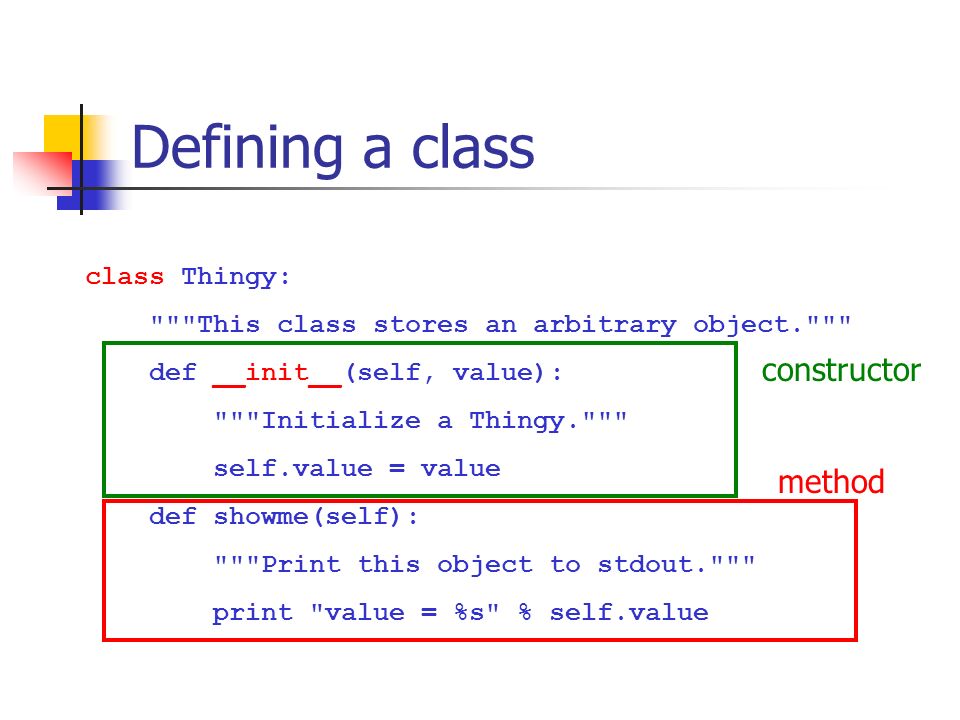
The concept of class in Python
One of the most essential concepts in object-oriented programming is the distinction between classes and objects, which is defined as follows:
In object-oriented programming, a class is a set of data (variables or attributes) and functions or methods that are members of a class.
Class data refers to variables that are input information stored in a class, whose attributes must be considered for each data point in the class. In-class functions are called class methods that determine class behavior.
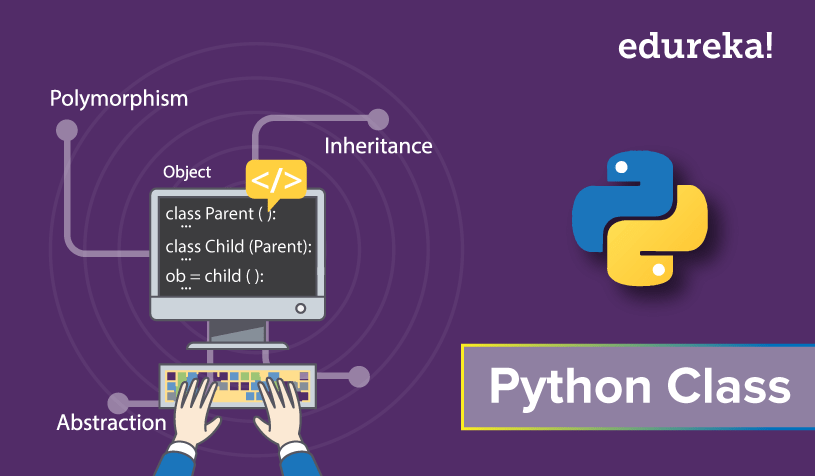
Input data is first stored in class variables and then used by class methods. In fact, using the class definition, you can find the number of objects needed in the class.
The object is an example of a class that can be used, and the relationship between the object and the class is the same as the relationship between the house and the map. As it is clear, using the drawn map, the house can be built and lived in. So any property that has a class will have an object or instance of it.
Attributes
Compared to other object-oriented programming languages, the class structure in Python is a combination of the mechanisms found in C++ and Modula. The class offers all the standard features of object-oriented programming, including:
- The inheritance mechanism is possible using several basic classes.
- A derived class can call each of its base classes by the same name.
- Available objects can contain arbitrary values and data types.
- As with modules, classes can take advantage of the dynamic nature of Python, meaning that they are created at runtime and can be modified after creation.
- Defined by the class keyword.
- Each code is written in indentation.
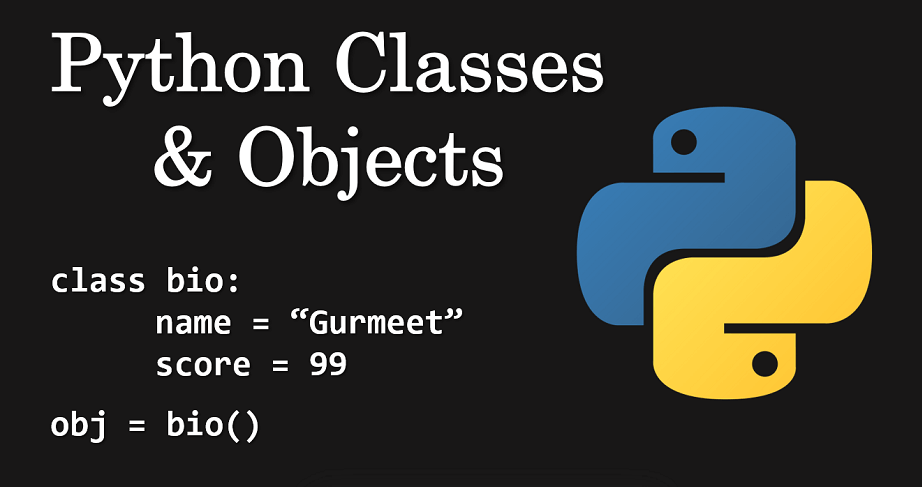
Class Definition in Python
As mentioned in the previous section, to define, you must first use the class keyword, then choose a name for your class, and finally write a two-dot operator. So the general rule is as follows:
1 2 3 4 5 | Class MyClass Statement 1 Statement 2 Statement 3 Statement n |
As you can see in the above command, the code inside the class in Python is written with respect to the indentation relative to the first line of code.
Definition of behavior
To define behavior within a class in Python, you must create a function inside the class but with a name other than _ _ init _ _, for example, a function called fullname that displays the firstname and lastname values together.
1 2 3 4 5 6 7 8 | class Person: def __init__(self, firstname, lastname, age): self.firstname = firstname self.lastname = lastname self.age = age def fullname(self): return self.firstname + ” “ + self.lastname |
In the code above, a function named fullname is defined with no input parameters.
In fact, here the self parameter is set by the interpreter and refers to the object on which the function is called.
In the code below, you can see that we use the fullname function.
1 2 3 | >>> person = person (“Hossein”, “Ahmadi”,30) >>> print(person.fullname()) Hossein Ahmadi |
When the code above is executed, Hossein Ahmadi is displayed in the output.
Existing objects
To define objects in a class in Python, you need to know that an object is an instance of a class. A class is like a plot, while an object is an instance of a plot with real values. An object contains the following:
State of:
An object’s state is determined by its properties and reflects those properties.
Behavior:
The methods of that object represent the behavior of an object and also represent the reaction of an object with other objects.
Identity:
A unique name is assigned to an object, enabling it to communicate with other objects.
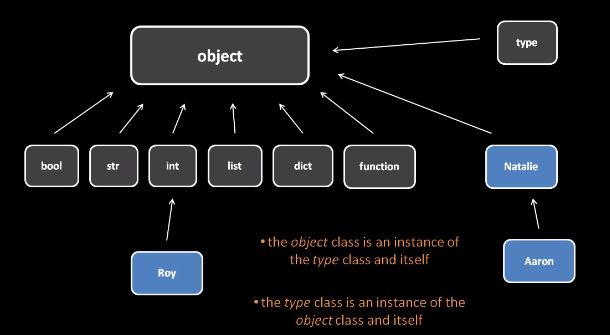
How to build an object
To access members of a class, they must be accessed through an object. After creating a class, you must first create an instance of the class in Python. As you are aware, an instance of a class is called an object, which is actually an instance variable of the corresponding class.
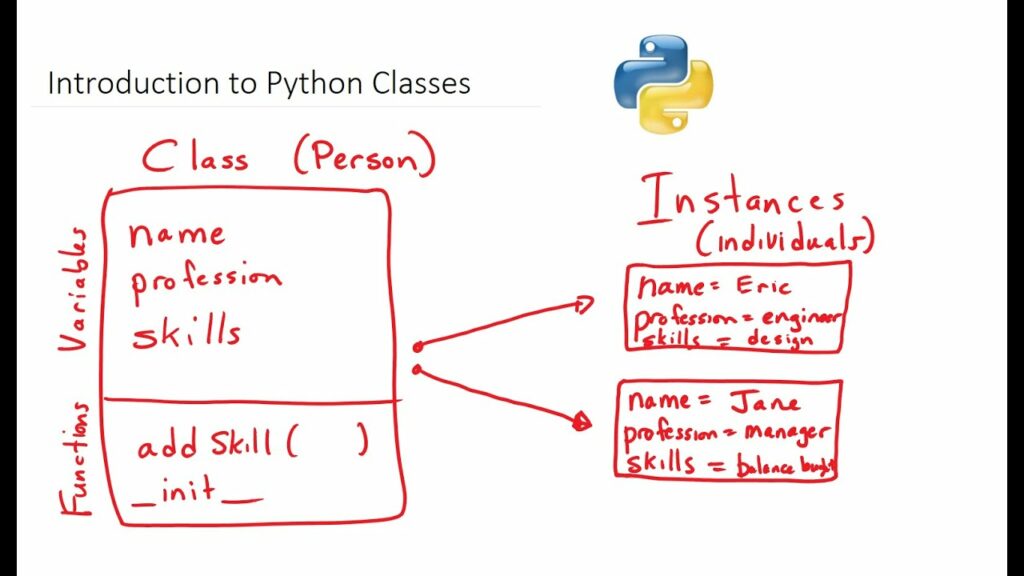
The first step after creating a class is to create an instance of it. As you are aware, an example of a class is called an object, which is an instance of the corresponding class.
In the Python programming language, all variables that are created from standard Python variants are instances of a class in Python. The following code snippet defines class variables representing the most common data types in Python.
1 2 3 4 5 6 7 8 9 10 11 12 13 14 | integer_variable = int () Print type(integer_variable) float_variable = float () Print type(float_variable) string_variable = float () Print type(string_variable) list_variable = float () Print type(list_variable) dictionary_variable = float () Print type(dictionary_variable) |
To use it, you must first create an object of that class before doing anything. The following code shows how to make a class object in Python.
1 2 3 4 5 6 7 8 9 10 | Class MyClass: Statement 1 Statement 2 Statement 3 … Statement n #object 1 Obj1 = ClassName() #object 2 Obj2 = ClassName() |
The following code is an example of defining a class in Python:
1 2 3 4 5 6 7 8 9 10 11 12 | Class Employee: ‘Common base class for all employees’ empCount = 0 def __init__(self, nam e, salary): self.name = name self.salary = salary Employee.empCount += 1 def displayCount(self): print “Total Employee %d” % Employee.em pCount def displayEmployee(self): print “Name: “, self. Name, “, Salary: “, self.salary |
The concept of empCount
It is a class variable shared by all class instances and can be accessed from both inside and outside the class. The __init__ method is a special method called the class constructor or the initialiser of the class, and whenever a new object of a class is created in Python, Python calls this method.
Other methods can be defined as functions, except that the first parameter must be self. When calling methods, Python creates the self parameter and does not require the programmer to set it.
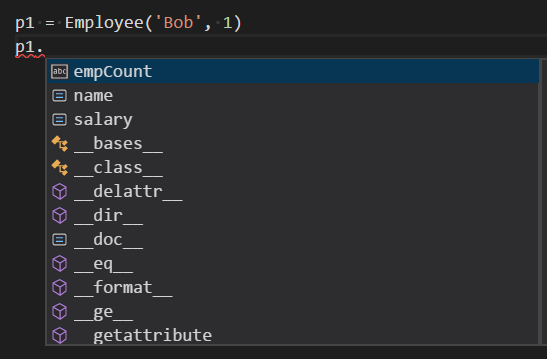
As you know, to create an object from a class in Python, it can be called using the class name, and its arguments can be set to values defined by the __init__ method.
1 2 3 4 | “This would create the first object of the Employee class.” emp1 = Employee(“Zara”, 2000) “This would create a second object of the Employee class.” emp2 = Employee(“Manni”, 5000) |
Use the phrase pass
The pass statement in a class definition in Python is the null statement; it does nothing when the program executes. In fact, when we want to define a class by its name, then its commands, and its body, we have to use the phrase pass. Consider the following example:
1 2 3 4 5 6 7 8 | class SampleClass1: pass class SampleClass2: pass sample1 = SampleClass1() sample2 = SampleClass2() |
sample1 and sample2 are instances of SampleClass1 and SampleClass2, respectively, but because the class bodies are not yet defined, both objects have no content.
Difference between sample variables and class variables in Python
Sample variables for data are unique to each instance, but class variables are for the attributes and methods that are shared by all class instances in Python.
In fact, sample variables are variables whose value is assigned inside a constructor or method, while class variables are variables whose value is assigned to a class. Note the following code:
1 2 3 4 5 6 7 8 9 10 11 12 13 14 15 16 | Class Dog: Kind = ‘canine’ # class variable shared by all instances def __init__(self, name): self. Name = name # instance variable unique to each instance >>> d = Dog(‘Fido’) >>> e = Dog(‘Buddy’) >>> d.kind # shared by all dogs ‘canine’ >>> e.kind # shared by all dogs ‘canine’ >>> d.name # unique to d ‘Fido’ >>> e.name # unique to e ‘Buddy’ |
As discussed in “One Word About Names and Objects,” shared data can have powerful effects when used with mutable objects, such as lists and dictionaries. For example, the list of tricks in the following code should not be used as a class variable in Python because only a single list is shared by all Dog items:
1 2 3 4 5 6 7 8 9 10 11 12 13 14 15 16 | Class Dog: Tricks = [] # mistaken use of a class variable def __init__(self, name): self.name = name def add_trick(self, trick): self.tricks.append(trick) >>> d = Dog(‘Fido’) >>> e = Dog(‘Buddy’) >>> d.add_trick(‘roll over’) >>> e.add_trick(‘play dead’) >>> d.tricks # unexpectedly shared by all dogs [‘roll over’, ‘play dead’] |
Call a class in Python.
Each class in Python can have different methods, which are the same functions as in the class. Methods can add other properties to the class or perform a specific task. Consider the following written class.
1 2 3 4 5 6 7 8 9 10 11 | class Person: def __init__(self, person_name, person_age): self.name = person_name self.age = person_age def Print_Person_Profile(self): print ‘Name: ‘, self. Name print ‘Age: ‘, self.age def Add_Phone(self, person_phonenumber): self.phone = person_phonenumber |
Call the whole module.
Calling a class is like calling a module. There are two ways to call a class:
1. Calling the whole class module in Python with the Import command: Note the following code:
1 2 3 4 5 6 7 8 9 | import MyClass P1 = MyClass.Person(‘Ali’, 26) P1.Print_Person_Profile() P1.Add_Phone(44556677) print P1.phone output Name: Ali Age: 26 44556677 |
2. Call one or more specific classes of the class module using the two commands import and from
1 2 3 4 5 6 7 8 9 | from MyClass import Person P1 = Person(‘Ali’, 26) P1.Print_Person_Profile() P1.Add_Phone(44556677) print P1.phone output Name: Ali Age: 26 44556677 |
It should be noted that as long as the class module name is called using the import command, the written description of the class and its methods can be extracted using the help command. You can also use the help command to display the descriptions of the functions defined in the document.
1 2 3 4 5 6 7 8 9 10 11 12 13 14 15 16 17 18 19 20 21 22 23 24 | import MyClass help (MyClass) output Help on module MyClass: NAME MyClass – Created on FILE c:\...\myclass.py DESCRIPTION @author: CLASSES Person class Person Methods defined here: Add_Phone(self, person_phonenumber) Print_Person_Profile(self) __init__(self, person_name, person_age) |
We hope this article has been of interest to you, dear programmers, and that you can use it effectively in your projects when working with the class in Python.
FAQ
What is a class in Python?
A class in Python is a blueprint or template that defines a set of attributes (data) and methods (functions) used to create objects (instances).
How does a class relate to object-oriented programming?
Classes support object-oriented programming by encapsulating data and behavior, enabling principles like modularity, reuse, inheritance, and abstraction.
What is the difference between a class and an object?
A class defines the structure and behavior; an object is a concrete instance of that class with actual data assigned.