


It is undeniable that the world now operates with Artificial Intelligence (AI). Many industries are adapting to change and have been compelled to modify their core infrastructure to harness the significant advantages of AI in their fields.
AI is no longer merely a concept; it has become a reality integrated into our daily lives. AI encompasses a very complex and broad spectrum of studies, much of which remains unexplored. Today, various AI models are used in the business world, making it crucial to understand their different types.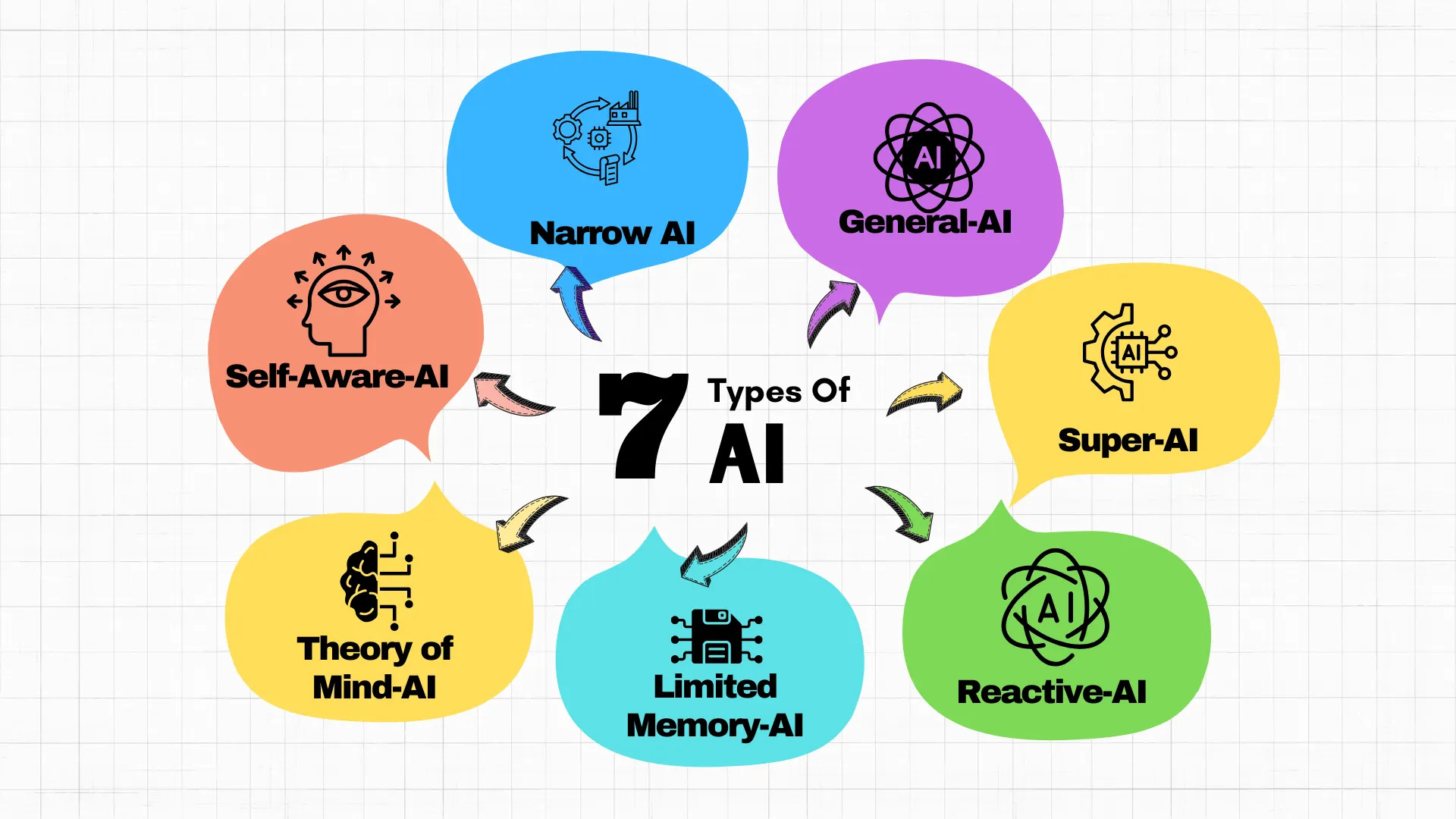

1. Narrow AI (Weak AI)
Narrow AI, or Weak AI, is a specific type of artificial intelligence designed to perform a particular task. More precisely, it refers to computer systems or programs that can execute only one specific, limited task, with their power confined to the job for which they were trained. This type of AI aims to perform a task automatically and intelligently, but does not perform well in other domains.
For example, chess programs powered by Narrow AI can defeat professional chess players. Still, they cannot perform well in other areas that require genuine conceptual interpretation and understanding, such as natural language processing. Facial recognition programs also fall under the Category of Narrow AI, which is designed to identify faces in images.
An autonomous driving program is another specific type of Narrow AI, designed to operate without human intervention. Narrow AI stands in contrast to Artificial General Intelligence (AGI), which is capable of performing any task a human can. Narrow AI is used in various domains, including healthcare, finance, retail, and more. It can improve efficiency, reduce costs, and provide better customer service.
Narrow AI has simplified specific tasks for us. However, it is essential to note that Narrow AI is not perfect and may perform specific tasks incorrectly. Therefore, when using it, one must be aware of its risks and verify its outputs to ensure correctness.
2. Reactive Machines
Reactive Machines are the most basic AI systems, with minimal capabilities, that attempt to respond to environmental stimuli by emulating the human brain. They do not require prior knowledge of the environment and can react quickly to environmental changes. Reactive Machines are trained using Reinforcement Learning.
This is a learning process where a machine learns to perform a task optimally through trial and error. By receiving rewards for actions that bring it closer to the goal, the machine knows it has accomplished the assigned task correctly. Reactive Machines are used in a wide range of applications, including automatic control, computer games, and robotics.
A simple reactive machine for human face detection operates by taking a human face as input and drawing a bounding box around it to identify it as a face. The model does not store or learn any data.
The cameras on smartphones operate based on such models. IBM’s Deep Blue, the intelligent model that famously defeated chess grandmaster Garry Kasparov in 1997, is a well-known example of reactive AI.
These intelligent systems respond solely to their current inputs and lack long-term memory for storing and retrieving information. They employ simple methods for processing input, and their performance is typically limited to the specific task for which they were designed.
Typically, Reactive Machines operate according to fixed rules and algorithms. They can respond to inputs with high speed and accuracy; however, their performance declines sharply in situations outside their training scope. In other words, Reactive Machines require precise, manual programming to perform specific tasks and cannot automatically respond to environmental changes or new functions without code modifications.
An example of a reactive machine is robots used in industrial production lines. They adjust their performance based on current input signals (e.g., sensors) and perform specific tasks on the assembly line, but they cannot develop a comprehensive understanding of the production line concept and process; they only respond according to predefined algorithms.
In general, Reactive Machines are considered part of intelligent systems, but their capabilities are more limited than those of higher levels of AI. Reactive Machines are still in early development but have the potential to effect a significant transformation. As these intelligent models continue to develop, we can expect them to become increasingly integrated into our daily lives.
3. Artificial Superintelligence (ASI)
Artificial Superintelligence (ASI), or Super AI, represents the pinnacle of AI research, as it will possess the highest level of intelligence on Earth. Due to its immense memory, faster data processing and analysis, and decision-making capabilities, ASI will surpass human performance in every task and will also mimic human brain function.
In general, ASI is more intelligent than humans and can perform most tasks better. ASI refers to a specific type of AI capable of simulating human emotions and experiences so accurately that not only are its behaviors understandable to humans, but it can also persuade people to perform actions.
Key characteristics of ASI include the ability to reason, solve problems, judge, and make decisions independently without human intervention. ASI remains hypothetical, but implementing such a system in tpracticewould fundamentally transform the gworld
4. Artificial General Intelligence (AGI)
Artificial General Intelligence (AGI) is intelligence that can perform any intellectual task as accurately as humans. Functionally, this AI model is related to the Theory of Mind, which will be discussed later. AGI does not yet exist, but some researchers believe it is only a matter of time before we achieve such intelligence, given the necessary infrastructure and knowledge to build it.
AGI could completely transform vast domains such as healthcare, finance, and education. However, some experts have warned that AGI could pose serious risks, such as widespread unemployment. It is essential to note that AGI is currently a theoretical concept and may become a tangible reality in the future. Nevertheless, it is essential to consider the potential risks and benefits of AGI.
Some potential benefits of AGI include:
-
It could be used to address some of the world’s most complex problems, such as the water crisis, global warming, or even the colonization of other planets.
-
It could play a significant role in improving our daily lives, particularly in transportation, healthcare, and education.
-
It could help us gain a more precise understanding of our world. Imagine providing AGI with data from the James Webb Space Telescope to yield valuable information about the cosmos.
Some potential risks of AGI include:
-
It could lead to massive unemployment, as machines could perform jobs and tasks currently done by humans more efficiently and accurately.
-
It could be used to develop autonomous weapons, posing serious potential dangers to humanity.
-
Finally, if such intelligence is developed and we lose control over it, it could be used to destroy humanity.
Currently, researchers are seeking ways to add human emotions and other skills to machines so they can behave in a human-like manner. It is worth noting that “Strong AI” is another name used for Artificial General Intelligence.
5. Limited Memory AI
The Limited Memory AI model is a specific type of artificial intelligence that can store and use information in a limited manner. In this model, prior information and knowledge are stored in memory and used as an information resource for future decision-making.
Limited-memory AI models are based on reinforcement learning algorithms. In these algorithms, an intelligent agent interacts with the environment, receives data, and makes decisions based on it. Empirical information is provided to the agent as input-output pairs, and the agent uses reinforcement learning algorithms to learn the rules and patterns within the data.
A Limited Memory AI model can store a limited number of past experiences and knowledge. This limitation may impair the model’s learning and decision-making capabilities, as older information remains in limited memory and can lead the model to overlook new details.
In general, Limited Memory models are more applicable to problems with rapid and dynamic changes. For example, a Limited Memory AI model could be used in computer game scenarios. In this situation, players’ prior states and experiences are stored and used to guide future moves.
However, these models typically have lower long-term efficiency compared to models with unlimited memory. In summary, the Limited Memory AI model strikes a balance between storage capacity and learning ability performsform wellcertainsome problems. Still, in other cases, it may not compete effectively with unlimited-memory models.
Today, systems with limited memory respond to and learn from feedback. Limited-memory AI systems combine the capacity to respond to prior data with the ability to learn from it.
Almost all current AI applications we are aware of fall into this category. All modern AI systems, including deep learning systems, are trained using vast amounts of training data stored in memory to create a reference model for addressing future problems.
For instance, an image recognition AI is trained to label objects by scanning hundreds of images and their corresponding labels. When an AI scans an image, it uses training images as a reference to interpret its content and, based on its training, labels new images with increasing accuracy.
6. Theory of Mind AI
Theory of Mind AI refers to a model that understands human emotions, personalities, and beliefs and possesses social interaction capabilities; however, there remains a long way to go to achieve this goal. This theory examines mental processes and capabilities, such as thinking, perception, decision-making, and knowledge transfer, and seeks to simulate them in AI models.
Theory of Mind AI seeks to answer questions such as “How can a machine think?” and “How can it understand and use knowledge?” This theory seeks to describe mental activities that demonstrate human superiority over other intelligent beings in performing certain tasks, such as critical thinking, problem-solving, and verbal/linguistic skills.
One of the most important concepts in Theory of Mind is the ability to understand and predict others’ perspectives and mental states. More precisely, it refers to the predictive power of machines.
Using Theory of Mind in AI could help develop systems capable of understanding and interacting with humans naturally. This theory could usher in a new stage in the design of intelligent user interfaces and machine-to-machine (M2M) systems.
This field remains a major challenge in AI, and researchers are striving to overcome technical limitations and to apply the Theory of Mind in AI by modeling human thought patterns.
Artificial Emotional Intelligence and advances in decision-making theory are two research areas that address this topic. It is worth noting that Michael I. Jordan presented part of his research on decision-making in the future of machine learning and AI at the event “Michael Jordan & Ion Stoica” on May 13, 2023, and provided more detailed information at the ICLR 2020 conference, the details of which are publicly available online.
7. Self-Learning AI
Self-learning in artificial intelligence refers to the ability of intelligent systems to learn and improve their performance without human intervention. In this approach, smart systems can collect data, analyze it, extract patterns and rules, and continue learning based on these patterns and rules.
Self-learning methods in AI can include machine learning models such as deep neural networks and reinforcement learning algorithms. In these methods, intelligent systems automatically detect patterns and rules using input data and signals and act accordingly.
Consequently, over time and with continuous use of data, the system’s performance improves.
Self-learning in AI offers advantages such as high flexibility, adaptability to environmental changes, and the ability to handle complex tasks. However, one significant challenge of self-learning is the need for large amounts of training data.
To achieve acceptable performance, intelligent systems require a diverse and sufficient set of input data to extract the necessary patterns and rules. Advances in technology and the development of machine learning methods have made self-learning in AI a hot topic in the field. Given the current state, it seems unlikely that this form of AI will be available to us in the near future.
However, we may achieve such a level of intelligence in the future. This is the intelligence that Elon Musk and Stephen Hawking have repeatedly warned us about developing.
Comprehensive and In-Depth Analysis:
This article provides a structured overview of seven AI models categorized by their capabilities and theoretical progression, moving from existing, limited forms to hypothetical, superintelligent ones. Here is a critical analysis of its content, structure, and implications:
1. Strengths and Content Evaluation:
-
Clear Categorization: The article successfully outlines a spectrum of AI, ranging from task-specific tools (Narrow AI, Reactive Machines) to learning systems (Limited Memory) and, finally, to aspirational, human-like, or superhuman intelligence (Theory of Mind, AGI, ASI, Self-Learning). This progression helps readers understand the field’s trajectory.
-
Practical Examples: The use of examples such as chess programs, facial recognition, self-driving cars, and industrial robots makes abstract concepts such as Reactive Machines and Narrow AI tangible to a general audience.
-
Balanced Perspective on AGI/ASI: The article commendably presents both the transformative potential and the existential risks of AGI and ASI, citing concerns from figures such as Hawking and Musk. This highlights the critical ethical and safety debates within the field.
-
Foundation in Established Concepts: It correctly identifies key AI paradigms, such as Reinforcement Learning, and distinguishes between purely reactive systems and those with memory.
2. Weaknesses and Ambiguities:
-
Overlapping and Non-Standard Categories: The classification system is somewhat muddled and doesn’t align perfectly with standard AI taxonomy.
-
Narrow AI vs. Limited Memory: The description of “Limited Memory AI” essentially describes most modern Machine Learning and Deep Learning systems, which are themselves prime examples of Narrow AI. Presenting them as separate categories is confusing. “Limited Memory” is better understood as a characteristic of current AI systems within the Narrow AI paradig,rather than ast a distinct type.
-
Self-Learning AI as a Distinct Category: “Self-Learning” is a capability (enabled by algorithms like reinforcement learning) rather than a standalone model type. Most advanced Narrow AI systems are, to some degree, self-learning or adaptive.
-
AGI and Theory of Mind: The article correctly links them, but could clarify that Theory of Mind is a prerequisite capability for a true AGI. An AGI would need a “theory of mind” to interact with humans on a human level.
-
-
Technical Inaccuracies/Simplifications:
-
Reactive Machine Training: Stating that Reactive Machines are trained using Reinforcement Learning is misleading. Classic reactive machines such ase Deep Blue) are not trainedusinga learning algorithms in the modern sense; they are hard-coded with rules and evaluation functions. They respond according to pre-programmed logic rather than learned rewards.
-
Chronological & Capability Confusion: The order and description sometimes conflate the chronological development of AI ideas with their hierarchical capability. For instance, Reactive Machines are historically early but not necessarily “more basic” than a modern Narrow AI image recognizer with memory.
-
-
Omission of Key Context: The article lacks discussion of the driving forces behind current AI (big data, computational power such as GPUs, transformer architectures) and the major commercial applications (LLMs such as GPT, diffusion models for image generation, recommendation systems) that dominate today’s landscape. These are the real “influential models” for most people.
3. Synthesis and Broader Implications:
The article’s core narrative reveals the central tension in AI: the relentless drive from specialized tools toward general intelligence. This journey is not linear, and the categories presented are more like landmarks on a complex map.
-
Present Reality: We live firmly in the era of Advanced Narrow AI with Limited Memory. Almost every impactful AI today—from ChatGPT and medical diagnosis tools to stock trading algorithms and autonomous drones—fits this description. They are highly proficient at specific tasks and learn from vast datasets, but lack understanding, consciousness, or generalizable common sense.
-
The Great Chasm: The article accurately highlights the vast gap between current “Limited Memory” AI and subsequent stages (Theory of Mind, AGI). Bridging this chasm is the fundamental challenge. It requires breakthroughs not only in scale but also in architecture, causal reasoning, embodied learning, and understanding of the social and physical worlds.
-
Ethical and Societal Imperative: By highlighting the risks of AGI/ASI, the piece underscores that AI development is not merely a technical problem but a socio-technical one. The discussions about alignment, control, bias, and economic disruption are urgent and must parallel technical research. The warnings about “losing control” point to the critical field of AI alignment research.
Conclusion:
The article serves as a useful introductory primer for conceptualizing the different ambitions within AI. It effectively cconveysthat AI is not a monolith but arather gspectrumof capabilities. However, its categorical framework is imperfect, blending capabilities, historical concepts, and theoretical future models.
For a reader, the key takeaway should be:
-
Today’s AI is powerful but narrow, operating as sophisticated pattern recognition and prediction tools within defined domains (the “Limited Memory” / Narrow AI combine).
-
The “Intelligence” we seek (Theory of Mind, AGI) involves a qualitative leap to understanding, reasoning, and social cognition, which remains largely out of reach and is the subject of intense research and speculation.
-
The ultimate endgame (ASI) raises profound questions about the future of humanity, making responsible development and governance the most crucial issues surrounding this technology.
The accurate “influential models” are the Narrow AI systems reshaping industries now, while the other categories represent the ambitious—and fraught—horizon of the field.