


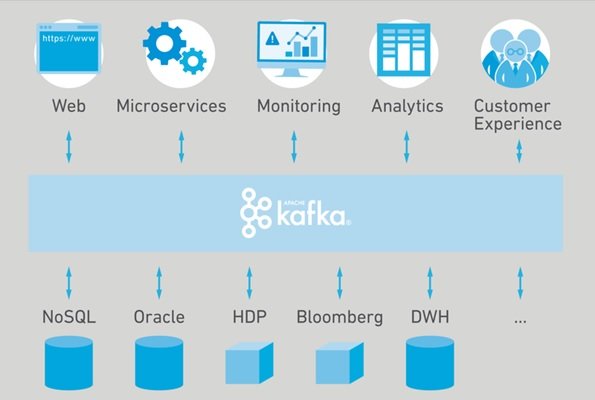
Apache Kafka is an open-source streaming platform developed by LinkedIn and donated to the Apache Software Foundation. This project aims to provide an integrated platform with high power and low latency for instant data. Its storage layer is a highly scalable, engineered (pub/sub) message queue associated with distributed transactions. Apache Kafka is an open-source streaming data processing platform written in Scala and Java.
Kafka and Spark are among the essential tools machine learning engineers use extensively.
Apache Kafka

The project aims to provide a robust, integrated, low-latency infrastructure for the immediate manipulation of input information. Its storage layer is distributed across multiple servers and scales for a server-queue architecture. Kafka is used for data processing (Stream Processing) and a messaging broker (Message Broker).
In addition, Kafka allows connection to external systems (for input/output data) via Kafka Connect and provides Kafka Streams. Kafka works best for managing large volumes of data that are constantly being sent and do not have enough time to be processed and stored. In addition, Kafka is well able to manage errors.
How to use Kafka?

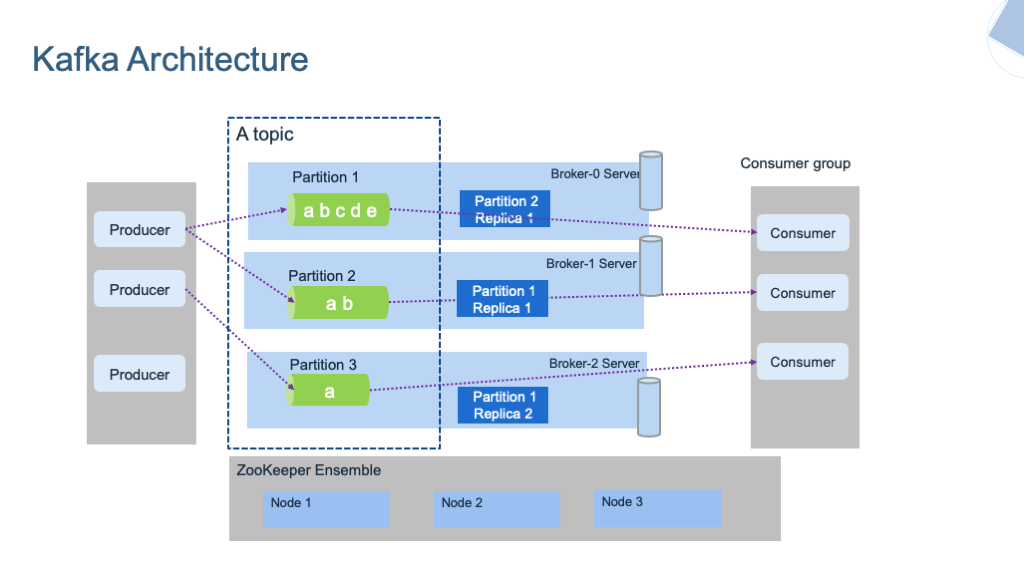
The first step in using Kafka is to build a Topic. From now on, new messages can be sent via TCP connection for storage in the new Topic. This can be done easily through client designs in different languages and for other platforms. These messages must then be stored somewhere. Kafka stores these messages in files called Logs.
New data is added to the end of the log files. Kafka can store incoming messages across a set of clustered Kafka servers. If, for example, there are Kafka servers in a cluster, the data associated with each message sent will be copied to all supported servers after being stored on the Leader server.
However, even if n-1 servers are decommissioned, the Topic data in question will still be available and usable.
Hence, tolerance for error is well seen in Kafka.
Clients can also read information stored on Kafka. The message-consuming client, the Consumer, must subscribe to a Topic to receive messages.
Upon implementing the Poll method, the data will flow to the Consumer.
When defining a new Topic, related data can be stored in multiple partitions. In fact, Kafka stores all messages sent to a Topic in all partitions in the same order.
In this storage model, each partition is stored on a server, and the other servers in the Cluster will copy the backup of that partition. This Kafka feature allows the co-consumer to receive information in parallel.
The Spark
Apache Spark is an open-source distributed computing framework. The software was initially developed by the University of California, Berkeley. The code was later donated to the Apache Software Foundation, which has maintained it ever since.
Spark provides an application programming interface for programming all clusters with parallel data parallelization and fault tolerance.
Spark stores program data in main memory, which makes programs run faster (unlike the mapping/reduction model, which uses disk for intermediate data).
Another factor that improves Spark’s performance is the use of the cache mechanism for data that is to be reused in the program.
This will reduce the overhead caused by reading and writing to disk.
An algorithm to implement in the mapping/reduction model may be divided into several separate programs. Each time the data is read from the disk, it must be processed and rewritten to the disk.
However, using Spark’s caching mechanism, the data is read from disk once, cached in main memory, and various operations are performed on it.
Using this method also significantly reduces the overhead caused by disk communication in programs and improves performance.
What components are Spark made of?
Spark Core: The Spark Core contains Spark’s core operations, including components for task scheduling, memory management, error handling, storage system interaction, and more.
The Spark kernel also supports the development of APIs that define RDDs, the core concept of Spark programming.
RDDs represent a set of items distributed across multiple computational nodes and can be processed in parallel.
The Spark kernel provides several APIs for creating and manipulating these collections.
Spark SQL:
Spark SQL is a framework for working with structured data. This query system supports SQL and Apache Hyo (another SQL dialect called HQL), and supports data sources such as Hyo tables, Parquet data structures, CSV, and JSON.
In addition to providing a SQL UI for Spark, Spark SQL enables developers to combine SQL queries with data modification operations on RDDs in Python, Java, and Scala, and to integrate SQL queries with complex analytics in a single application…
This close integration with Spark’s processing environment sets Spark SQL apart from other open-source data warehousing tools.
Spark Streaming:
The Spark Streaming data processing component is one of Spark’s components that provides data stream processing. Examples of data streams include log files generated by web servers and messages containing status updates sent by web service users or posted on social networks.
This component provides APIs for modifying data streams that are compatible with the APDs for RDDs in the Spark Core. This facilitates application Development and switches between applications that store data in main memory or on disk. The actual process can be. In the Development architecture of these APIs, to achieve fault tolerance, high productivity, and scalability, as in the Spark core component, attention has been paid to aspects of developing distributed systems.
MLlib:
Spark has a library of machine learning (ML) APIs called MLlib. MLlib offers a variety of machine learning algorithms, including classification, regression, clustering, and group refinement, and supports features such as model evaluation and data loading.
MLlib also provides low-level machine learning primitives, such as gradient descent optimization algorithms. These methods are designed to run programs at the Spark cluster level.
GraphX:
GraphX is a library for processing graphs and parallelizing graph computations. Like Spark Streaming and Spark SQL, GraphX provides RDD APIs and enables us to create directed graphs by assigning specifications to each node and edge. GraphX also provides various operators for changing graphs (such as subgraph and map vertices) and a library of graph algorithms (such as PageRank and counting graph triangles).
FAQ
What is Apache Kafka used for?
Apache Kafka is used to stream, buffer, and distribute large volumes of real-time data between systems — commonly for messaging, event ingestion, log aggregation, metrics collection, and data pipelines.
How does Kafka differ from a traditional message queue?
Unlike typical queues that delete messages after consumption, Kafka retains data in durable, append-only logs — allowing multiple consumers to read the same data independently at different times.
What are key strengths of Kafka’s architecture?
Kafka offers high throughput, low latency, horizontal scalability, fault tolerance through replication, and data durability — making it suitable for large-scale, real-time, distributed software systems.