



Open Radio Access Network (O-RAN) is an open standard for cellular communication networks.
O-RAN has been developed to increase flexibility and scalability and reduce costs in telecommunications networks.
One of the most important reasons for using O-RAN networks is the ability to use interchangeable components, which allows telecommunication service providers to deploy different hardware and software in the RAN. More precisely, it will enable operators to choose telecommunications equipment based on their needs and requirements, rather than being forced to use products from a single brand.
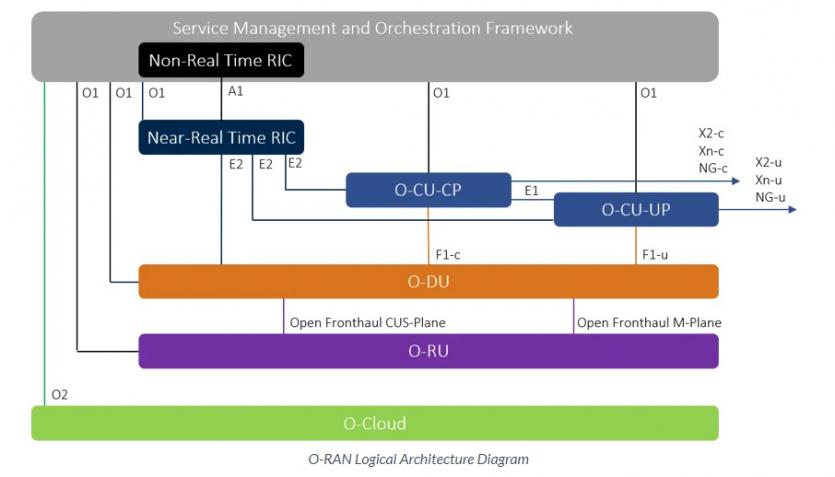
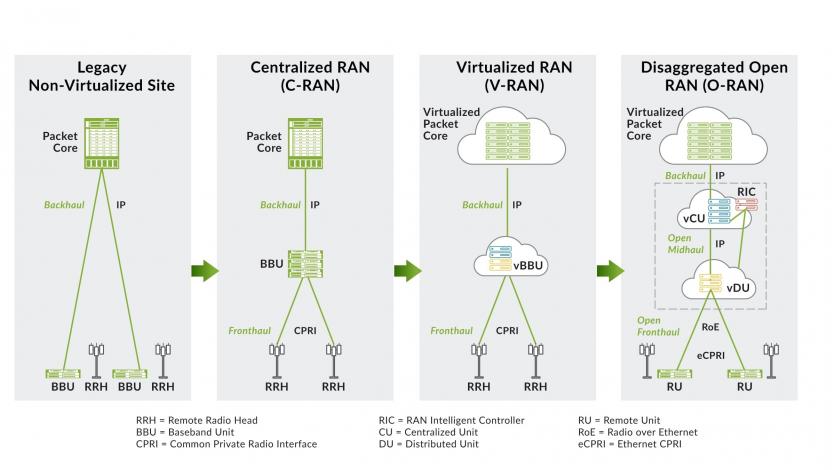
O-RAN comprises the Central Unit (CU), Distributed Unit (DU), and Radio Unit (RU) layers, which communicate via standardized interfaces and O-RAN-compliant software, thereby improving network performance.
When a network is implemented according to the O-RAN standard, it enables virtualization and supports a range of hardware types. This approach helps operators increase network capacity, reduce costs, and introduce new services that improve the user experience for their subscribers.
What layers does O-RAN consist of? O-RAN is based on the principles of virtualization and Hardware-Software Disaggregation, so that companies are not compelled to use products from a single vendor. Therefore, companies can use software and hardware equipment from various suppliers.
Using the O-RAN architecture, communication operators will be able to manage the infrastructure more precisely, avoid specific limitations when selecting RAN components, and combine and use different hardware components.
O-RAN is currently supported by the O-RAN Alliance, which includes various operators and suppliers from the telecommunications industry. The main goal of this alliance is to promote and advance the use of the O-RAN architecture and to develop common standards and solutions to further its adoption.


Analysis
The article provides a clear, concise overview of the Open Radio Access Network (O-RAN), positioning it as a revolutionary shift away from traditional, vendor-locked Radio Access Network (RAN) architectures.
1. Key Concepts and Goals:
-
Definition: O-RAN is fundamentally an open standard for cellular networks, backed by the O-RAN Alliance.
-
Primary Objectives: The technology aims to achieve three critical goals in the telecom sector: increased flexibility, improved scalability, and reduced costs.
2. Mechanism of Operation (The „Open“ Factor):
-
Disaggregation: The core principle is Hardware-Software Disaggregation, in which software functions are separated from hardware components.
-
Interchangeability: This disaggregation enables the use of interchangeable components from multiple vendors, breaking the traditional „vendor lock-in“ model in which a single supplier provides the entire end-to-end RAN solution.
-
Architecture Split: The RAN is functionally divided into three main components: the Central Unit (CU), the Distributed Unit (DU), and the Radio Unit (RU), which communicate via standardized open interfaces.
3. Benefits:
-
Vendor Choice and Competition: Operators gain the freedom to select best-of-breed equipment tailored to their specific needs, fostering competition and potentially driving down equipment prices.
-
Virtualization: The architecture supports virtualization, enabling network functions to run on commercial-off-the-shelf (COTS) hardware, which is typically cheaper and easier to manage than proprietary telecom equipment.
-
Innovation and Customization: Increased flexibility and the ability to mix and match components accelerate the deployment of new services and allow for more precise infrastructure management.
-
Capacity and User Experience: Ultimately, the implementation of O-RAN is expected to boost network capacity, lower operating expenses, and enhance the overall user experience.
4. Broader Context:
O-RAN is a key trend in the evolution toward 5G and beyond, where networks must be more agile, cloud-native, and capable of supporting diverse applications such as IoT and Edge Computing. By moving away from proprietary „black box“ solutions, O-RAN enables operators to integrate new technologies more quickly and build more resilient, customizable networks, thereby democratizing the RAN market.
Market Challenges and Reality Check
Despite the technological progress, the O-RAN market faced headwinds in 2024:
-
Slowing RAN Investment: Global RAN market revenue has contracted, with declines in key markets like the U.S. and Japan as the main 5G rollouts mature. This broader slowdown affects O-RAN adoption.
-
Slower-Than-Expected Adoption: O-RAN revenues specifically came in weaker than anticipated. Some analysts reported a significant drop in O-RAN market activity as initial greenfield buildouts concluded and „brownfield“ (integration into existing networks) adoption proved more challenging.
-
Interoperability and Integration Complexity: While O-RAN promises multi-vendor flexibility, integrating components from different suppliers seamlessly remains a significant technical and operational hurdle. Operators often prefer the reliability and streamlined support of a single-vendor system, even if it uses O-RAN-compliant standards.
-
Commercial Readiness: Technical readiness, particularly for next-generation interfaces such as the O-RAN ULPI (U-plane Low-Phy Interface), remains limited, hindering broader commercial adoption.
Key Technological Advancements
Despite market volatility, the core O-RAN technology continues to mature, driven by the O-RAN Alliance and industry groups like the Telecom Infra Project (TIP):
1. The Role of the RIC and AI/ML
The RAN Intelligent Controller (RIC) is the brain of the O-RAN architecture. There’s a strong focus on using AI/ML frameworks and applications (rApps) on the RIC to drive advanced use cases:
-
Energy Efficiency: Optimizing power consumption across the network based on real-time traffic.
-
QoS Optimization: Dynamically improving Quality of Service and user experience.
-
Automation: Automating network management and optimization tasks.
2. Focus on Security
As O-RAN introduces a multi-vendor, disaggregated architecture, security is a top priority. New technical requirements focus on robust security frameworks, including a zero-trust approach, to protect the open interfaces and cloud infrastructure from vulnerabilities.
3. Non-Terrestrial Networks (NTN)
The O-RAN architecture is being integrated with Non-Terrestrial Networks (NTN)—such as satellites in Low Earth Orbit (LEO)—to provide connectivity in areas where terrestrial networks are nonexistent. This extends the reach and applicability of the open standards.
The overall takeaway is that O-RAN is transitioning from the initial pioneering phase (Greenfield) to a more complex, slower, but strategically essential Brownfield integration phase within established carriers.
Operators remain highly confident that O-RAN’s core benefits—vendor choice, virtualization, and AI-driven automation—will ultimately deliver long-term cost savings and innovation.
FAQ
What does Open RAN mean?
Open RAN refers to a telecom network architecture where RAN components are disaggregated and connected via open, standardized interfaces — allowing equipment and software from different vendors to work together seamlessly.
Why is Open RAN considered beneficial?
It increases vendor diversity and competition, reduces deployment and maintenance costs, allows more flexible upgrades, and helps operators adopt new services or improvements more rapidly.
What are the main components of an Open RAN architecture?
Key parts include the Radio Unit (RU), Distributed Unit (DU) and Centralised Unit (CU), often implemented virtually (software-based). Additionally, a RAN Intelligent Controller (RIC) can provide advanced management and optimization — sometimes using AI/ML — over the network.